Calculating Commercial Linear Metre Yield across Variable Fabric Cuttable Widths
Cuttable width excludes defective margins, converting linear metres directly to true usable area and determining actionable garment output per bulk lot.


Web
Full fabric rolls contain non-usable edge margins that are unusable for apparel pattern layout. Buying fabric on gross roll width without adjusting for these non-performing boundaries causes immediate financial losses on the cutting table. The nominal width printed on a mill specification sheet typically measures the overall distance from selvedge edge to selvedge edge.
Commercial utility depends entirely on cuttable width, defined as the net continuous width of clean, defect-free textile falling within specified weight and construction tolerances.

Selvage Architecture and Edge Waste
Woven and knitted textiles display structural variances along their lateral boundaries due to loom gripping mechanisms, catch cords, and stenter clip attachments. On shuttleless weaving machinery, tuck-in devices or leno motion bindings create dense, stiff selvedge strips that alter fabric thickness and local yarn density. Projectile and rapier looms leave fringe selvedges that fray during handling and catch during spreading operations.
Knitted fabrics exhibit edge curling driven by unbalanced internal loop torque, requiring glued or gummed margins that render the outer two to three centimetres structurally rigid and chemically contaminated.
Selvages carry no commercial value. Pattern markers placed across functional garment panels must never encroach upon selvedge structures due to differential shrinkage and stiffness. A poplin weave with a dense leno selvedge shrinks at a lower rate than the balanced plain weave body during wet processing, producing edge puckering if cut into garment components.
Physical edge defects and pin holes render the outer fifteen to twenty-five millimetres on each selvedge useless for garment pattern layout.

Stenter Pin Marks and Boundary Distortions
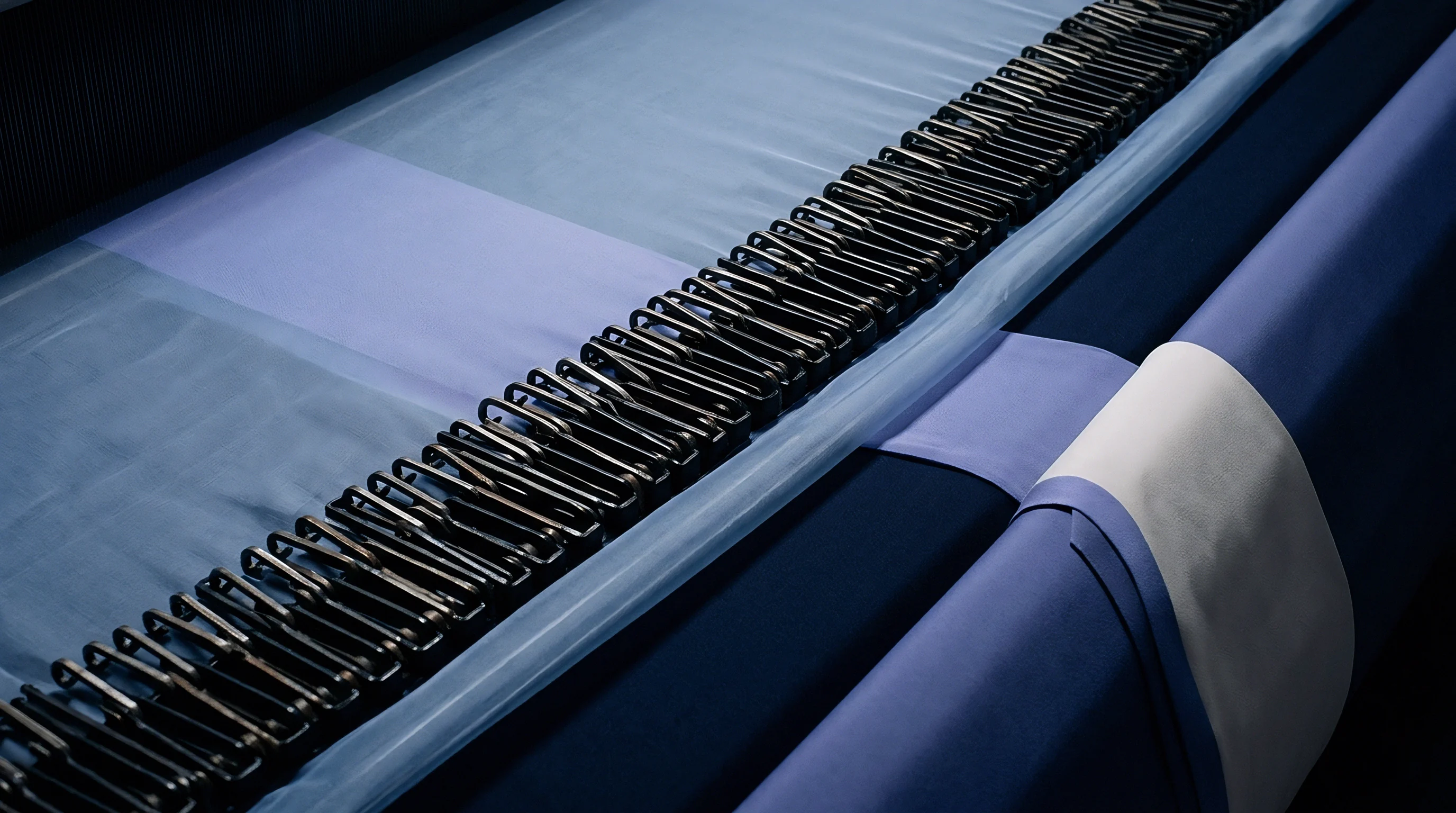
Mechanical drying and heat-setting frames rely on physical transport chains that pierce or clamp the outer strips of wet cloth during drying. Stenter pin chains leave distinct perforations spaced along the outer margins. Tenter clips crush the edge yarns, creating glazed marks and distorted weave geometries.
These pin holes and mechanical clamp depressions extend five to twenty millimetres inward from the selvedge line.
Edge trim allowance accounts for these physical boundary defects. When calculating material consumption, the cuttable width calculation subtracts the full width of both edge zones from the gross roll width. The table below outlines standard physical boundary losses across common fabric structures and finishing routes.
| Fabric Construction | Finishing Transport Method | Gross Width Range (cm) | Total Edge Loss (cm) | Usable Cuttable Ratio (%) |
|---|---|---|---|---|
| Cotton Poplin (Comb Woven) | Pin Stenter with Trim Knife | 150 to 152 | 3.0 to 4.0 | 97.4 to 98.0 |
| Cotton-Elastane Jersey (Knit) | Gummed Edge with Pin Stenter | 165 to 170 | 6.0 to 8.0 | 95.1 to 96.3 |
| Polyester Canvas (Coated) | Clip Stenter without Trim | 148 to 150 | 4.0 to 5.0 | 96.6 to 97.2 |
| Cotton Twill 3/1 (Jet Dyed) | Pin Stenter with Rotary Cutter | 152 to 154 | 3.5 to 4.5 | 97.1 to 97.7 |
| Data derived from ISO 22198 conditioning standards at 20 degrees Celsius and 65 percent relative humidity. Edge loss values include total allowance for both left and right selvedge regions. | ||||
Dyehouse managers routinely defend these edge losses by claiming that wide selvedge pins are necessary to maintain cross-rail tension and prevent bow distortion during heat setting.


Arithmetic
Conversions between nominal linear length and net usable area depend on accurate cuttable dimensions across every shipped roll. Fabric purchasing invoices traditionally express volume in linear metres. Garment manufacturing yields, however, are governed by surface area calculated in square metres.
A failure to map variable cuttable widths directly into net surface area leads to severe discrepancies between budgeted and actual garment unit yields.

Mathematical Formulations for Square Metre Yield
Calculating total surface area requires multiplying the measured usable span by the total rolled length in linear units. The standard formula for total usable area (Au) expressed in square metres is:
Au = L × left( fracWc100 right)
Where L represents total linear metres and Wc represents the net cuttable width expressed in centimetres. When calculating yield per linear metre (Yl), the relation converts to:
Yl = fracWc100 quad (m2/m)
Linear metres mask true yield. A roll measuring one hundred linear metres with a nominal width of one hundred and fifty centimetres yields one hundred and fifty square metres of raw material. If the net cuttable width drops to one hundred and forty-two centimetres due to pin-hole encroachment and selvedge curl, the actual usable yield contracts to one hundred and forty-two square metres, representing a total loss of eight square metres per roll.
A three-centimetre reduction in cuttable width on a 150-centimetre specification reduces total usable fabric area by exactly two percent across the entire production lot.
Mass Shifts and Density Changes across Finishing
Fabric weight per unit area increases directly as lateral shrinkage compacts the warp and weft yarns into a tighter grid during wet processing. Mass per unit area is governed by ISO 3801 and expressed in grams per square metre. Compaction during sanforizing or stenter overfeeding reduces linear yield while raising mass per unit area.
The total weight of a fabric roll (Mr) in kilograms is derived from length, cuttable width, and conditioning weight:
Mr = L × left( fracWg100 right) × left( fracGSM1000 right)
Where Wg represents gross width in centimetres and GSM represents conditioned weight per square metre. If a mill over-stretches fabric to meet a requested cuttable width specification, mass per unit area drops below target tolerances, causing structural weakness and excessive washing shrinkage in finished garments.
Worked Calculation for Bulk Order Surface Area
Consider a purchase contract specifying ten thousand linear metres of cotton twill with a nominal specification of one hundred and fifty centimetres. The agreed weight is two hundred and twenty grams per square metre. The contract permits a gross width tolerance of plus or minus two centimetres, but specifies a minimum cuttable width of one hundred and forty-five centimetres.
Assume three distinct delivery scenarios across a bulk shipment of one hundred rolls:
- Scenario A baseline build maintains an average gross width of one hundred and fifty-two centimetres and a cuttable width of one hundred and forty-seven centimetres. Total usable yield equals fourteen thousand seven hundred square metres.
- Scenario B narrowed width build delivers an average gross width of one hundred and forty-seven centimetres and a cuttable width of one hundred and forty-two centimetres. Total usable yield drops to fourteen thousand two hundred square metres, creating a shortfall of five hundred square metres.
- Scenario C irregular edge build maintains a gross width of one hundred and fifty-two centimetres but suffers deep pin-hole damage, reducing cuttable width to one hundred and forty-one centimetres. Usable area drops to fourteen thousand one hundred square metres.
Density rises as width contracts. In Scenario B, the yarn density increases per unit area, altering fabric drape and hand feel. In Scenario C, the buyer pays for unused yarn mass bound up in non-performing edge scrap.
Calculating conversion factors prior to marker creation protects against unaccounted scrap rates.
Broader fabrics consistently achieve superior area conversion efficiencies compared to narrow rolls processed under identical tension conditions.


Variance
Lateral dimension stability shifts continuously across wet processing and mechanical drying operations. Fabric does not emerge from a dyehouse with identical dimensions from end to end or from roll to roll. Understanding the root physical drivers of width drift enables sourcing teams to set realistic tolerances in technical specifications.

Structural Drivers of Lateral Fluctuation
Loom tension differences, uneven yarn crimp distribution, and asymmetrical ring spinning torque induce non-uniform relaxation during washing. In woven textiles, warp yarn tension on the loom beam holds the filling yarns under severe lateral strain. Once released from loom controls, elastic recovery causes immediate width contraction, termed grey off-loom shrinkage.
During jet dyeing, rope transport exposes fabric to intense hydraulic forces and localized mechanical squeezing. Fabrics dyed in rope form suffer severe cross-wise contraction compared to open-width jig or pad-batch dyeing routes. Knitted structures exhibit even higher volatility; loop geometry changes shape readily under longitudinal tension, causing lateral narrowing known as Poisson ratio strain in flexible structures.
Tension shifts alter finished dimensions. The following factors drive cuttable width fluctuations across bulk production lots:
- Yarn crimp imbalance occurs when differential sizing or warping tension forces weft yarns to bend unevenly around warp ends, resulting in variable width contraction during desizing.
- Jet dye rope tension stretches circular knits lengthways inside transport tubes, causing cross-wise narrowing that stenters cannot permanently correct without setting high residual shrinkage.
- Stenter chain width drift arises from mechanical wear or improper manual positioning of rail settings along the drying chamber, creating a continuous width taper along the length of a single roll.
- Hydro-extraction pressure variations leave irregular moisture levels along roll edges, causing uneven thermal setting rates during subsequent drying passes.
- Elastane thermal decay happens when stenter heat-setting temperatures exceed the stability threshold of polyurethane filaments, destroying elastic recovery and causing irregular fabric relaxation.

Thermal Setting and Overfeed Mechanics
Synthetic fibres and elastane blends experience significant dimensional shifts when exposed to heat inside the stenter chamber. Overfeed mechanics allow wet fabric to enter the stenter pins at a higher linear velocity than the chain speed. Overfeed prevents lengthways shrinkage.
Heat setting locks polymer orientation.
If a dyehouse forces a fabric to a wider cuttable dimension by applying excessive lateral tension on the stenter rails, the synthetic polymer chains set in a strained state. Upon subsequent laundering or steam pressing, the frozen internal stress releases, forcing the garment panel to shrink dramatically along the cross-grain.
| Process Variable | Operational State | Target Cuttable Width Impact | Width Variation Across Lot | Downstream Structural Risk |
|---|---|---|---|---|
| Stenter Rail Width Setting | Over-stretched (+4 cm) | Artificially Expanded | High (+/- 3.0 cm) | Severe Laundering Shrinkage |
| Stenter Longitudinal Overfeed | High Overfeed (+15%) | Contracted (+2 to +3 cm GSM) | Low (+/- 0.8 cm) | Increased Weight per Metre |
| Dyeing Format | Jet Rope Dyeing | Narrowed (-5 cm) | Moderate (+/- 1.8 cm) | Edge Creasing and Skewing |
| Compactor Moisture Level | Non-uniform (12% delta) | Variable Across Roll | High (+/- 2.5 cm) | Differential Garment Sizing |
How far can a dyehouse safely adjust stenter rail width on a cotton-elastane blend before residual thermal instability triggers skewing during apparel pressing operations?


Profiling
Standardized inspection protocols establish systematic routines to record effective usable width at regular intervals along every roll. Cuttable width is never uniform across a fifty-metre roll length. Measuring width solely at the lead end of a roll creates false assumptions regarding total surface area yield.

Standardized Inspection Frameworks and Test Methods
International guidelines ISO 22198 and ASTM D3774 define the precise physical procedures for measuring cuttable dimensions on open-width cloth. Standard inspection protocol ISO 22198 requires cuttable width measurements to be taken at least one metre from roll ends across three distinct points along the roll length. The measured points must be unrolled without applying longitudinal tension on an inspection frame inclined at forty-five degrees.
Measurements recorded during four-point inspection routines log three critical values: overall gross width, clean cuttable width, and minimum continuous cuttable width. The minimum continuous cuttable width governs marker planning. If a fifty-metre roll measures one hundred and forty-eight centimetres cuttable for forty-five metres, but narrows to one hundred and forty-two centimetres for a five-metre middle section, the effective cuttable rating for the entire roll reverts to one hundred and forty-two centimetres unless the narrow section is physically cut out.
Roll Categorization and Binning Routines
Grouping incoming shipments by cuttable width bands prevents severe operational losses in automated cutting rooms. Binning routines classify fabric rolls into precise width bins before cutting room release. Roll binning protects cutting efficiency.
Unsorted rolls create cutting waste.
Incoming inspection frames utilize precise logging steps to profile bulk arrivals:
- Mount the fabric roll on a tensionless unrolling frame equipped with automated edge guidance and calibrated digital length counters.
- Condition the inspection area to standard atmosphere parameters of twenty degrees Celsius and sixty-five percent relative humidity per ISO 139.
- Unroll the fabric at speeds not exceeding fifteen metres per minute, checking for selvedge curling, glue contamination, and mechanical pin degradation.
- Record net cuttable width measurements using a calibrated steel rule at five-metre intervals, ignoring outer non-performing selvedge structures.
- Identify and mark width transitions where cuttable span contracts by more than fifteen millimetres below nominal specification.
- Assign each inspected roll to a dedicated width bin category based on its minimum continuous cuttable measurement across the entire length.
Under international standard inspection principles, any bulk delivery where more than ten percent of inspected rolls fall below the contracted minimum cuttable threshold permits the buyer to issue an immediate hold on the entire shipment pending technical re-evaluation.


Nesting
Pattern marker planning translates physical fabric area into cut garment panels with minimal scrap generation. Automated marker making software packs complex geometric pattern shapes within a defined rectangular border representing the cuttable fabric boundary. Marker efficiency is expressed as the percentage of total cuttable fabric area converted into actual garment pieces.

Where Does Variable Cuttable Width Break Lay Efficiency?
Spreading multi-roll plies on an automated table forces marker planners to set perimeter limits to match the narrowest roll in the stack. If a spreading lay contains twenty plies measuring one hundred and forty-eight centimetres wide and two plies measuring one hundred and forty-four centimetres wide, the marker must be set to one hundred and forty-four centimetres. The additional four centimetres on the twenty wider plies falls outside the cutting line, turning usable main-body cloth into waste edge scrap.
Markers demand uniform cuttable limits. Spreading unsorted rolls together creates step-lay waste and edge shearing errors. Automated cutting heads cut along pre-programmed CAD coordinates.
If a ply boundary narrows unexpectedly, pattern pieces positioned near the edge are cut incomplete, resulting in rejected garment components.
Marker layouts generated for the narrowest roll in a shipment waste usable material when spread across wider rolls without re-nesting.
Differential Width Spreading and Marker Allocation
Sorting fabric inventory into strict tolerance groups allows garment factories to run optimized marker layouts for each width band. Modern garment factories utilize three standard marker bands spaced at two-centimetre intervals. The decision matrix below structures marker allocation strategy based on incoming width distribution profiles.
- Narrow band marker configurations run layout widths set to minimum contracted tolerances, absorbing low-width rolls without generating incomplete panel cuts.
- Standard band marker configurations match nominal specification widths, handling the bulk distribution of inspected inventory with balanced nesting efficiency.
- Wide band marker configurations capture bonus material from oversized rolls, running high-yield patterns that reduce total linear consumption per garment unit.
- Step-lay spreading protocols cut shorter ply stacks for narrow rolls, preventing wide underlying plies from wasting edge material in uniform lay stacks.
Failing to segregation rolls by cuttable width bands prior to lay planning forces cutting floors to run all markers at the absolute narrowest roll limit, destroying budgeted material consumption ratios and inflating unit costs per cut panel.

Docket
Commercial purchase agreements explicitly state whether unit pricing applies to gross length or net cuttable area. Sourcing transactions executed solely on price per linear metre leave buyers completely unprotected against systemic width fluctuations. Professional supply contracts link billing terms directly to net usable surface area delivered at the cutting table.

Contractual Specifications and Tolerance Thresholds
Legal fabric purchasing documents establish clear lower bounds below which width deviations incur monetary penalties or trigger lot rejections. A well-constructed fabric specification separates gross width tolerance from cuttable width minimums. While gross width may carry a tolerance of plus or minus two percent, cuttable width carries an absolute minimum threshold.
Contracts specify standard width bands alongside short-shipment adjustment clauses. The agreement defines acceptable width distributions across bulk shipments, setting explicit commercial caps on lower-tier width allocations.
| Contract Clause | Standard Specification Limits | Commercial Surcharge / Debit Trigger | Financial Settlement Mechanism |
|---|---|---|---|
| Minimum Cuttable Floor | Nominal minus 2.0 cm absolute | Delivery below minimum floor | Full lot rejection or supplier re-finishing |
| Width Bin Distribution | Max 5% in narrowest bin band | Exceeding 5% narrow bin quota | Pro-rata debit memo on area loss |
| Selvedge Edge Margin | Max 2.0 cm per selvedge side | Edge losses exceeding 4.0 cm combined | Linear metre conversion price credit |
| Weight vs Width Shift | GSM within +/- 5% at set width | Over-stretching to meet cuttable target | Quality penalty for low structural density |

Financial Adjustment and Yield Debits
Settling balance payments following incoming inspection relies on converting missing cuttable area into equivalent linear metre deductions. Gross width billing inflates material cost. Cuttable width defines billable yield.
Shortfall debits balance area losses. Width claims require precise logging.
When an incoming four-point inspection confirms that a bulk shipment averages a cuttable width of one hundred and forty-two centimetres against a contracted specification of one hundred and forty-six centimetres, the buyer calculates the percentage area loss:
Loss Ratio = 1 – left( frac142146 right) = 0.0274 quad (or 2.74%)
The buyer issues a formal short-shipment debit memo deducting two point seven four percent from the invoice linear metre total prior to releasing balance payments. Alternatively, the supplier delivers supplemental linear yardage equivalent to the lost surface area at no additional charge. Professional purchase orders embed these formulas directly into the commercial terms, ensuring that monetary value stays anchored to actionable garment panel yield rather than non-performing edge waste.