Calculating Commercial Mass Regain Adjustments for Dehaired Specialty Animal Fibres
Commercial mass regain adjustments recalculate dehaired specialty fibre billing weight by converting net scale mass to clean dry keratin plus official allowances.
Mass
Dehaired specialty fibres like cashmere, mohair, alpaca, and vicuña take on moisture rapidly through the porous keratin structure of fine animal hair. Without the protective cuticle of coarse guard hair, water molecules in ambient air bind directly to hydrophilic amino acid residues throughout the exposed cortex. As a result, net bale weights fluctuate constantly during transit, warehousing, and combing.
A 500-kilogram lot of dehaired cashmere baled in an arid climate can take on up to 25 kilograms of water weight while sitting in a humid port warehouse awaiting customs clearance. Invoicing specialty hair on unadjusted gross or net scale weights exposes trade counterparties to substantial financial variance.
Commercial mass calculations resolve this by converting fluctuating ambient weights into a standardized invoice mass. This calculated figure pairs the absolute dry weight of the fibre lot with an internationally recognized percentage allowance for moisture regain and residual grease. Without commercial mass adjustments, transactions remain at the mercy of relative humidity swings across international shipping lanes, producing unearned windfalls or losses based solely on the weather on the day of weighing.

Thermodynamic Regain versus Commercial Allowances
Equilibrium moisture regain is the physical percentage of water a bone-dry fibre absorbs when conditioned to equilibrium in a standard testing atmosphere of 20 degrees Celsius and 65 percent relative humidity. Commercial regain, by contrast, is a negotiated, legally binding percentage established by bodies like the International Wool Textile Organisation or ISO. These agreed allowances reflect the moisture clean fibre naturally retains under conventional mill conditions.
Mechanical dehairing fundamentally alters regain dynamics by stripping away coarse guard hairs, vegetable matter, and high-fat suint. Guard hairs carry thick, heavily keratinized cuticle sheaths with low absorption capacity compared to the fine undercoat. Once dehaired, the fine fibre mass presents a substantially larger surface area to surrounding air.
Dehaired cashmere and fine alpaca reach equilibrium regain far faster than greasy fleece as a result. Sales contracts have to reflect these physical realities by specifying commercial regain rates established for dehaired animal hair rather than default greasy wool figures.
Standard atmosphere regain for dehaired cashmere stabilizes at 13.00 percent at 20 degrees Celsius and 65 percent relative humidity.

Mathematical Structure of Weight Adjustments
Establishing commercial mass requires reducing the as-received net weight of a delivery to its clean, oven-dry base before adding the contractually agreed commercial percentages. The net weight on the weighbridge comprises three elements: clean dry keratin, absorbed moisture, and solvent-extractable grease or spin finish. Invoicing adjustments recalculate the payable mass by comparing contracted regain and grease allowances directly against the moisture and fatty matter percentages measured in the testing laboratory.
If a contract specifies a commercial regain of 13.00 percent and a residual fatty matter allowance of 1.50 percent, the authorized additions total 14.50 percent over the oven-dry mass. Should testing show an actual moisture regain of 16.20 percent alongside 2.10 percent residual fatty matter, the consignment carries excess water and unremoved grease. The calculation isolates the pure dry keratin, discards the uncontracted non-fibre weight, and reapplies the agreed percentages.
Neglecting commercial regain calculations leaves buyers paying pure-fibre prices for ambient humidity and scouring residue.
Core
Extracting a dependable sample from a high-density bale of dehaired fibre demands dedicated pressure coring and strict sample isolation. Moisture is rarely uniform through a pressed bale of cashmere or alpaca: outer layers absorb or release humidity within hours of arrival, while the core remains at whatever moisture level existed during baling. Surface grab sampling captures surface exposure rather than the true state of the shipment.
Standard core sampling rules in ISO 6741-1 and IWTO-19 call for coring through the full depth of the bale with a sharpened, rotating stainless steel tube driven under steady pressure. The cutter moves through successive packed layers, pulling out a continuous core of fine fibre. Technicians take cores from a randomized selection of bales across the lot to satisfy statistical criteria.
Each core must drop straight into an airtight, non-hygroscopic container the moment it clears the tube to prevent moisture loss to the surrounding air.
Core Sampling Equipment and Storage Standards
Coring tubes use inside diameters between 12 and 19 millimeters to cut clean cores without generating heat that scorches the fibre. Dull cutting edges generate friction heat that volatilizes light organic fractions in the hair, distorting oven-dry results. Extracted cores have to be transferred immediately into clean, airtight aluminum canisters or heavy-gauge polyethylene bags sealed with pressure clips.
| Parameter / Specification | IWTO-19 Standard Specification | ISO 6741-1 Standard Specification | Operational Tolerance |
|---|---|---|---|
| Coring Tube Internal Diameter | 12.5 mm to 15.0 mm | 12.0 mm to 19.0 mm | ± 0.2 mm |
| Minimum Sampling Rate (Lots > 10 Bales) | 100% of bales, 1 core per bale | 20% of bales, min 5 bales | Strict adherence required |
| Sample Container Material | Seamless aluminum container | Heavy polyethylene (> 100 µm) | Vapor transmission < 0.01 g/m²/24h |
| Maximum Container Transfer Time | 30 seconds post-extraction | 45 seconds post-extraction | Immediate sealing mandatory |
| Sample Weight per Consignment | Minimum 150 grams | Minimum 200 grams | + 50 g buffer for re-testing |

Field Sampling Procedure for Dehaired Bales
Executing an accredited core test on dehaired specialty animal hair requires careful adherence to the sampling protocol.
- Verify that the total lot weight matches the shipping manifest, recording the gross scale weight of every individual bale on calibrated digital platform scales prior to coring.
- Select bales for sampling using a randomized grid pattern, ensuring sampled units span top, middle, and bottom tiers of the shipping pallet or container container arrangement.
- Drive the mechanical coring probe horizontally into the center of the bale face, penetrating parallel to the direction of bale compression to capture cross-sectional fibre variations.
- Transfer the cut core specimen directly from the coring tube plunger into a pre-weighed, tared airtight container without touching the fibre with bare hands.
- Seal the container cap immediately, lock the mechanical latch, and record the combined mass of the container and wet sample to 0.001 grams precision on a portable field balance.
- Transport sealed containers to the testing laboratory in insulated transport cases maintained between 15 and 25 degrees Celsius to prevent moisture condensation on internal container walls.
Moisture disputes typically divide over whether water uptake took place during maritime transit or inside the receiving warehouse after container seals were broken.

Oven
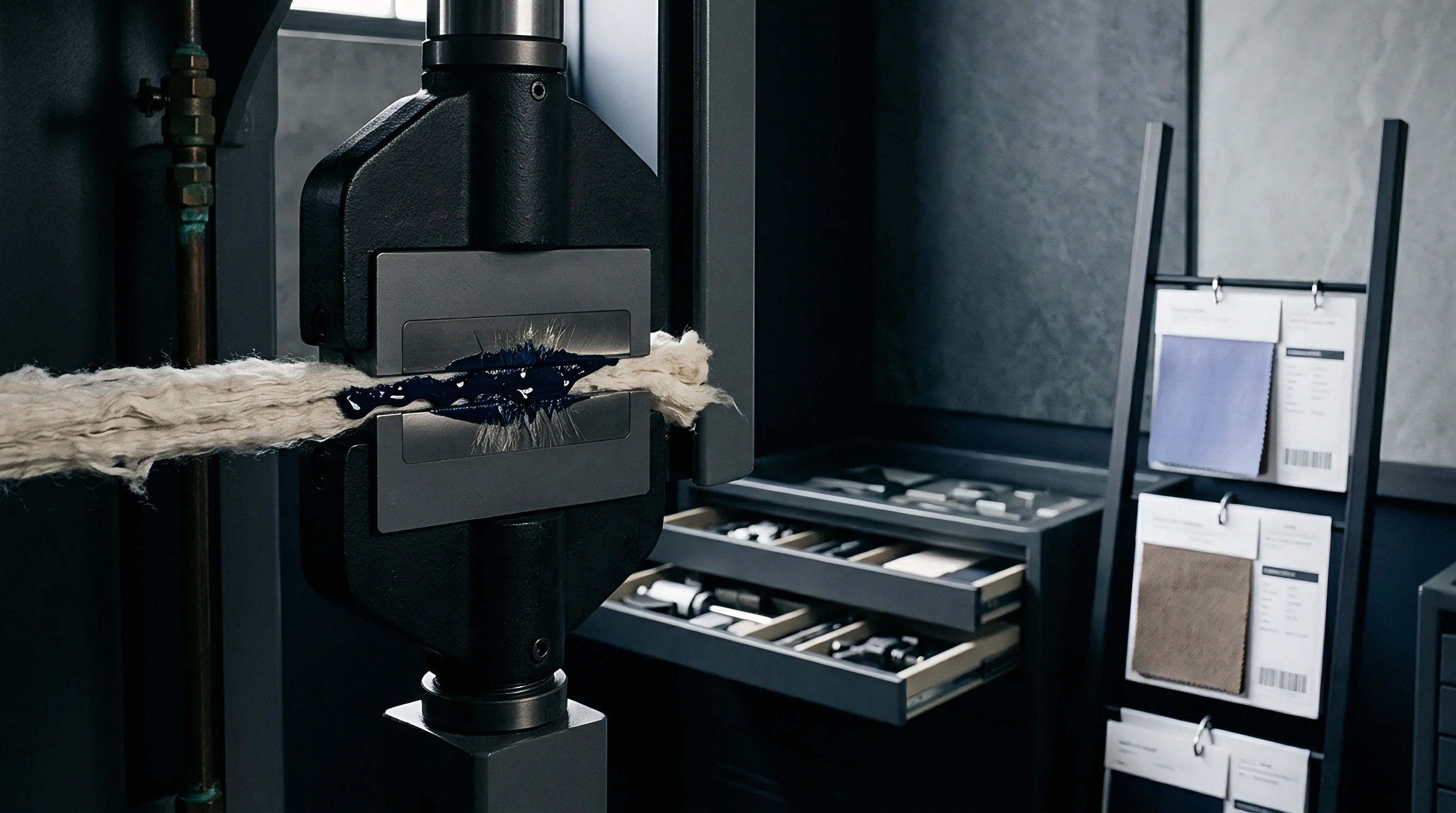
Determining the clean dry mass of dehaired fibre involves drying core samples in forced-air ovens until all water has been driven off. Test procedures ISO 6741-2 and IWTO-33 specify passing a continuous stream of heated air at 105 degrees Celsius ± 2 degrees Celsius through the specimen. Drying continues until successive weighings 15 minutes apart differ by less than 0.05 percent, establishing that all free moisture has cleared.
Water is not the only fraction driven off during heating. Residual volatile fatty acids, carding lubricants, and processing oils also volatilize at 105 degrees Celsius. Distinguishing volatile grease from true water loss requires pairing thermal drying with chemical solvent extraction.
Dichloromethane extraction, run to ISO 1833-1 or IWTO-10 protocols, washes out residual wool fats, natural waxes, and processing oils. Measuring dry mass without deducting solvent-extractable grease distorts the true yield of clean keratin.
| Fibre Description | ISO 6741 Commercial Regain (%) | IWTO Commercial Regain (%) | Standard Fatty Allowance (%) | Typical Measured Range (%) |
|---|---|---|---|---|
| Dehaired Cashmere (Capra hircus laniger) | 13.00 | 17.00 | 1.50 | 12.50 to 14.50 |
| Dehaired Camel Hair (Camelus dromedarius) | 13.00 | 17.00 | 1.50 | 11.80 to 13.50 |
| Dehaired Alpaca (Vicugna pacos) | 13.00 | 16.00 | 1.00 | 11.00 to 13.00 |
| Dehaired Mohair (Capra hircus aegagrus) | 13.00 | 17.00 | 1.50 | 12.00 to 14.00 |
| Dehaired Vicuña (Vicugna vicugna) | 13.00 | 16.00 | 1.00 | 10.50 to 12.50 |
Derivation of the Commercial Mass Equation
Calculating commercial mass involves isolating the clean, dry keratin content, subtracting measured non-keratin impurities, and applying the contracted allowances. Let Mr equal the net as-received weight of the consignment, Rm equal the measured laboratory moisture regain percentage, Fm equal the measured solvent-extractable fatty matter percentage, Rc equal the contractually agreed commercial moisture regain percentage, and Fc equal the agreed commercial fatty matter allowance percentage.
The oven-dry mass of the sample (Md) is calculated using the measured moisture regain derived from the mass loss during forced-air drying at 105 degrees Celsius:
Md = Mr × left( frac100100 + Rm right)
Adjusting for measured fatty matter requires isolating the clean, dry, fat-free keratin mass (Mk):
Mk = Md × left( frac100 – Fm100 right)
Applying contractual allowances for moisture regain (Rc) and fatty matter (Fc) yields the official Commercial Mass (Mc):
Mc = Mk × left( 1 + fracRc + Fc100 right)
Combining these relationships into a single operational formula produces the standard trade adjustment equation:
Mc = Mr × left( frac100100 + Rm right) × left( frac100 – Fm100 right) × left( frac100 + Rc + Fc100 right)
Contracts specifying IWTO-19 core sampling without residual fatty matter determination expose buyers to unadjusted grease mass billed at fibre prices.
Worked Construction: Cashmere Mass Adjustment Calculation
A buyer contracts for a nominal 2,500.00-kilogram lot of dehaired Mongolian cashmere under trade terms specifying an ISO commercial regain (Rc) of 13.00 percent and a commercial fatty matter allowance (Fc) of 1.50 percent. Upon arrival at the port warehouse, the gross scale weight minus packaging tare confirms an as-received net mass (Mr) of 2,545.00 kilograms. Core samples are extracted, sealed, and sent to an accredited testing laboratory.
Laboratory testing returns a measured oven-dry moisture regain (Rm) of 15.40 percent (indicating atmospheric water absorption during sea transit) and a measured dichloromethane-extractable fatty matter (Fm) of 2.20 percent (indicating incomplete scouring). Substituting these empirical figures into the operational equation allows direct calculation of billable mass.
First, calculate the oven-dry mass (Md) of the as-received consignment:
Md = 2545.00 × left( frac100100 + 15.40 right) = 2545.00 × left( frac100115.40 right) = 2205.372 kg
Next, isolate the clean, fat-free keratin mass (Mk) by removing the measured 2.20 percent fatty matter from the dry mass:
Mk = 2205.372 × left( frac100 – 2.20100 right) = 2205.372 × 0.978 = 2156.854 kg
Finally, apply the authorized contractual additions (Rc = 13.00%, Fc = 1.50%, total addition = 14.50%):
Mc = 2156.854 × left( frac100 + 13.00 + 1.50100 right) = 2156.854 × 1.145 = 2469.60 kg
The adjusted commercial mass equals 2,469.60 kilograms. Despite receiving a physical shipment weighing 2,545.00 kilograms on arrival scales, the buyer pays for 2,469.60 kilograms. The 75.40-kilogram adjustment removes 51.53 kilograms of uncontracted water weight and 23.87 kilograms of uncontracted residual processing grease.
Sources of Systematic Laboratory Error
Testing specialty animal fibres introduces systematic errors if handling diverges from the underlying test methods.
- Incomplete Solvent Removal leaves residual solvent traces in extraction thimbles, artificially inflating measured fatty matter figures.
- Oven Temperature Variations exceeding the ± 2 degrees Celsius threshold cause incomplete drying at lower temperatures or thermal degradation of keratin protein chains at elevated temperatures.
- Desiccant Saturation in cooling desiccators permits core samples to reabsorb ambient moisture from air pockets prior to dry mass weighing.
- Scale Calibration Drift on micro-balances distorts mass readings of small core aliquots, multiplying small errors into large commercial lot discrepancies.
Standard commercial supply contracts incorporate IWTO-19 clause 7, rendering official certificate weights binding provided sample extraction occurs within 72 hours of container discharge.

Discrepancy
Commercial disputes regularly arise when certificates calculated under ISO rules run up against figures calculated using IWTO wool standards. ISO standards for dehaired specialty fibres cap commercial regain at 13.00 percent, whereas standard IWTO regain tables assign a 17.00 percent regain derived from combed wool tops. On a 10-tonne lot of dehaired alpaca, invoicing under IWTO rules yields an extra 354 kilograms compared to an ISO calculation, creating a large valuation variance on identical physical fibre.
Clear contract drafting prevents these disagreements before shipments arrive at destination. Purchase agreements should explicitly cite the governing standard body, the test method code, the commercial regain percentage, and the residual grease limit. Broad references to customary trade practice leave room for sellers to invoke wool-top regain figures during delivery into European or Asian processing hubs.
| Test Scenario / Condition | Measured Regain (%) | Measured Fat (%) | Calculated Mass (kg) | Invoice Settlement (USD) | Variance vs Nominal (USD) |
|---|---|---|---|---|---|
| Contract Baseline (ISO Specs) | 13.00 | 1.50 | 1,000.00 | 130,000.00 | 0.00 |
| Elevated Transit Humidity | 16.50 | 1.50 | 969.96 | 126,094.80 | – 3,905.20 |
| High Residual Fat Content | 13.00 | 2.80 | 986.80 | 128,284.00 | – 1,716.00 |
| Combined High Regain & High Fat | 17.20 | 3.10 | 948.42 | 123,294.60 | – 6,705.40 |
| Dry Ambient Warehouse Transit | 10.50 | 1.20 | 1,025.68 | 133,338.40 | + 3,338.40 |
Customs Classification and Tariff Duty Valuation
Customs authorities classify dehaired specialty animal hair under Chapter 51 of the Harmonized System, under heading 5102 for fine animal hair, not carded or combed. Import duties, tariff rate quotas, and value-added taxes are assessed against customs value, which officers determine directly from invoice amounts.
Filing import entries on physical net scale weight rather than certified commercial mass introduces clear audit exposure. When a shipment takes on water during an ocean voyage, paying duty on unadjusted gross scale weight inflates landed import taxes. Conversely, if cargo dries out in transit, entering unadjusted scale weights under-declares the taxable commercial quantity, exposing the importer to misdeclaration penalties and duty recalculations.
Customs entries must match the official core test certificate issued under the referenced testing standard.
Ambient warehouse humidity shifts container weights before the laboratory seal breaks.

Commercial Audit Verification Steps
Auditing landed invoices requires checking several points before approving cross-border payments.
- Certificate Verification matches test certificate numbers against accredited laboratory databases to confirm testing authenticity and sample origin details.
- Standard Alignment Check confirms that laboratory calculation formulas used the contractually mandated standard regain rather than default wool top tables.
- Tare Weight Validation verifies that declared container packaging weights match actual physical packaging tare weights recorded at scale stations.
- Dichloromethane Extractable Audit checks measured fatty matter values against contract maximums to ensure un-scoured processing grease is deducted from billable mass.
Core sampling conducted after processing or carding invalidates commercial weight claims under standard international trade terms.

Invoice
Settling specialty fibre contracts requires incorporating commercial mass adjustments directly into financial invoicing. In modern practice, final settlement invoices rest exclusively on certificates issued by neutral testing laboratories. Letters of credit open against the nominal contract weight, with settlement clauses dictating final balance payments based on certified commercial mass.
| Invoicing Component | Pro Forma Base | Certified Final Base | Commercial Adjustment |
|---|---|---|---|
| Physical Scale Net Weight | 2,500.00 kg | 2,545.00 kg | + 45.00 kg (Water/Fat gain) |
| Oven-Dry Fibre Keratin Mass | 2,183.41 kg | 2,156.85 kg | – 26.56 kg (Keratin deficit) |
| Contractual Allowances (+14.50%) | 316.59 kg | 312.75 kg | – 3.84 kg (Allowance delta) |
| Final Payable Commercial Mass | 2,500.00 kg | 2,469.60 kg | – 30.40 kg Net adjustment |
| Financial Settlement at USD 140/kg | USD 350,000.00 | USD 345,744.00 | – USD 4,256.00 Credit memo |
Setting clear contractual tolerance bands prevents disputes over minor atmospheric fluctuations. Many supply contracts apply a non-adjustment threshold of ± 0.50 percent commercial mass variation. If certified mass lands within this band, counterparties invoice at original contract weight.
Once variation exceeds 0.50 percent, the adjustment applies to the full difference, keeping commercial cash flows aligned with actual delivered fibre.
Custom duty assessments depend on declared dry mass rather than green bale invoice mass.
Documentary instructions in international trade contracts must tie the bill of lading, customs declaration, and commercial invoice directly to the same core test certificate. Inconsistencies between invoice weights and customs filings draw administrative scrutiny and delay port release. Reconciling shipping paperwork with certified commercial mass ensures orderly customs clearance and dependable raw material accounting at the mill.
Uncertainties persist regarding how emerging online, real-time near-infrared moisture sensors installed inside bale presses will interact with traditional laboratory oven-drying standards during official trade disputes.