Determining Moisture Regain Corrections for Cotton Yarn Density
Correcting cotton yarn density for moisture regain standardizes commercial invoiced mass and prevents package dyeing defects caused by swelling.

Equilibrium

Polymer Structure and Moisture Sorption Dynamics
Cotton fibers take up ambient water vapor rapidly, driven primarily by the non-crystalline zones of the cellulose polymer chain. Native cotton cellulose has a crystallinity between 65 percent and 70 percent, which leaves the remaining 30 percent to 35 percent of the network accessible to water. In these amorphous regions, free hydroxyl groups bind with atmospheric moisture through hydrogen bonding.
An initial monomolecular layer forms directly on the accessible hydroxyl sites before additional moisture builds polymolecular layers within the cell wall, swelling the fiber cross-section and expanding its diameter by up to 14 percent.
Calculating yarn density depends on keeping moisture regain distinct from moisture content. Regain measures the water mass in a yarn sample against its oven-dry mass, whereas moisture content expresses that water weight as a fraction of the total moist sample mass. Conflating the two skews yarn count values and disrupts mass projections across commercial weaving and knitting.
Standard cotton regain reaches exactly 8.5 percent when calculated against oven-dry mass under standard testing conditions of 20 degrees Celsius and 65 percent relative humidity.
Ambient conditions govern how much water the fiber holds. Under ISO 139, standard conditioning for textile testing calls for 20 degrees Celsius and 65 percent relative humidity, adjusted in tropical test labs to 27 degrees Celsius at the same 65 percent relative humidity. If yarn equilibrates in an uncontrolled room, its linear density drifts noticeably: swelling changes the yarn’s cross-sectional shape, packing fraction, structural twist angle, and volumetric density.
High relative humidity swells native cotton fibers.
Equilibrium is further complicated by hysteresis. A dry cotton yarn brought upward to balance in a given room holds less moisture than a wet yarn dried down to that same air, leaving a regain spread of 0.9 percent to 1.5 percent between the adsorption and desorption curves. Because the yarn’s prior storage history dictates its exact regain at the scale, verifying a true baseline requires complete pre-conditioning desiccation.


Desiccation
Oven Drying Protocols and Gravimetric Verification
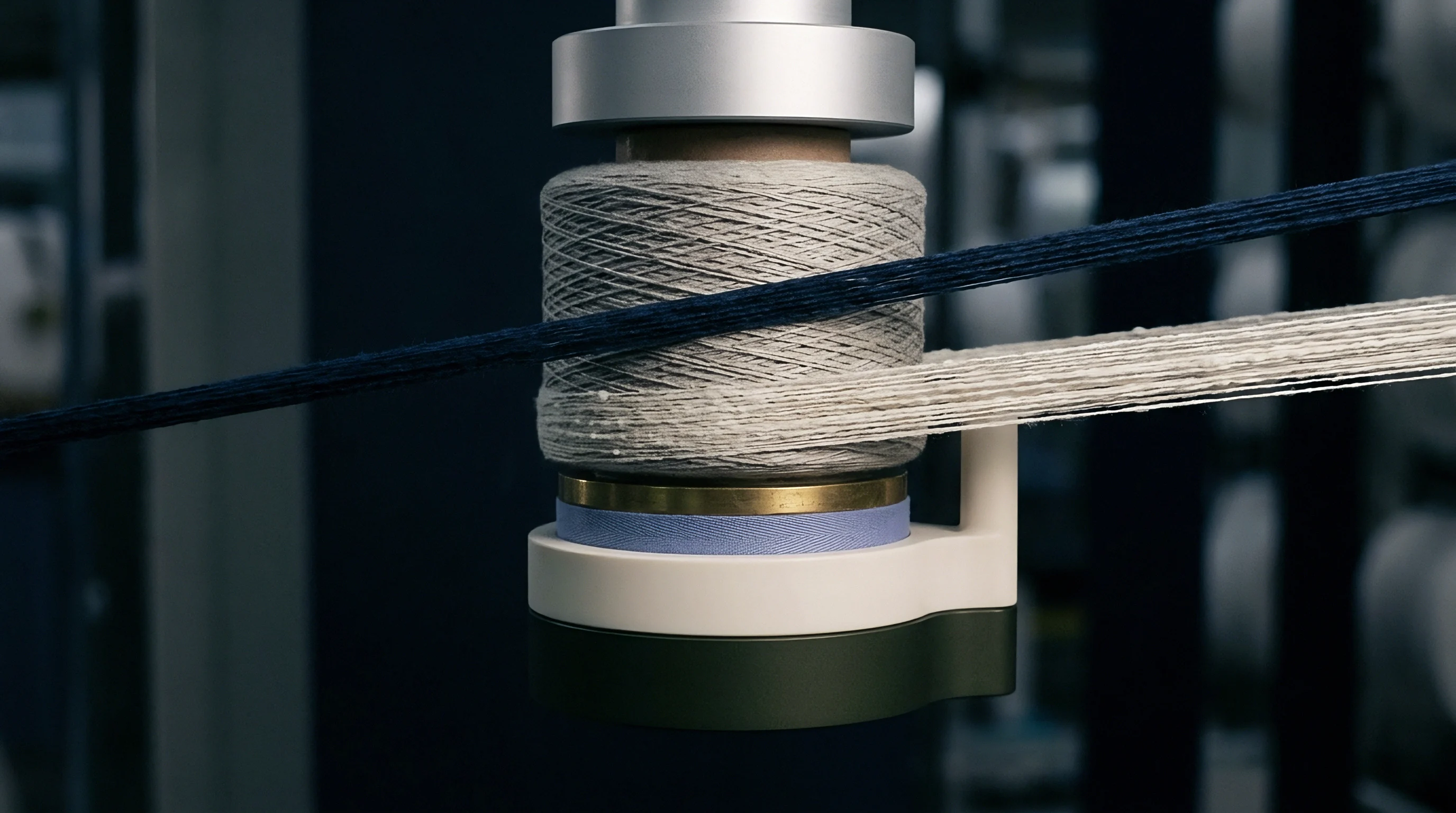
Pinning down true moisture regain in the laboratory requires absolute desiccation. Under ISO 2060, the standard gravimetric method for linear density relies on an oven-dry specimen heated in a ventilated chamber at 105 degrees Celsius plus or minus 3 degrees Celsius. A continuous stream of heated air sweeps through the chamber to carry off evaporating moisture.
Moisture shifts the yarn linear density. The run continues until back-to-back weighings spaced 15-minute intervals apart show less than 0.1 percent mass change.
Buoyancy forces also skew dry mass values. Weighing a hot skein straight out of the chamber sets up convection currents and air density gradients that disrupt an analytical balance. To prevent this, the sample must cool in a sealed desiccator loaded with active silica gel or molecular sieves before the final reading.
Some ventilated ovens integrate balances with suspension hooks inside the chamber, though the circulation fans must be switched off briefly while taking the reading.
- Reel a skein of known length using a calibrated yarn reel under a standardized tension of 0.5 centinewtons per tex.
- Record the initial mass of the moist specimen immediately on a calibrated analytical balance with a precision of 0.001 grams.
- Transfer the specimen to the ventilated drying oven maintained strictly at 105 degrees Celsius.
- Expose the sample to heated air circulation for a minimum initial period of 60 minutes.
- Perform preliminary weighing and return the sample to the oven for consecutive 15-minute drying intervals.
- Stop the drying cycle when mass loss between consecutive weighings drops below 0.1 percent of the total sample mass.
- Cool the specimen inside a sealed desiccator for 30 minutes if external balance weighing is utilized.
- Calculate the dry specimen mass and derive actual regain using the initial unconditioned mass figure.
Alternative Regain Measurement Technologies
Few production floors can pause for the hours required by gravimetric oven drying. Direct electrical resistance meters and high-frequency capacitive sensors provide near-instant alternatives, the latter tracking dielectric shifts caused by water in the yarn body. Both require calibration against gravimetric oven baselines for the specific cotton origin, count, and twist factor being run.
Leftover waxes, non-cellulosic matter, and salt residues from wet processing can all distort conductance readings.
| Measurement Method | Standard Reference | Testing Duration | Precision Tolerance | Destructive State |
|---|---|---|---|---|
Oven tests that ignore non-aqueous volatiles will produce skewed regain figures. Raw cotton carries pectins, natural fats, and waxes that slowly vaporize during prolonged exposure to 105 degrees Celsius, while spin finishes and coning oils picked up in carding or combing drive off as well. Without a solvent extraction step to isolate finish losses, an operator will record evaporated oils as lost water and systematically over-correct linear density across subsequent lots.
Correction

Mathematical Formulations for Direct and Indirect Systems
Adjusting yarn density for regain depends on the numbering system involved. In direct systems like Tex or Denier, linear density tracks moisture directly: as regain climbs, weight per unit length rises with it, elevating the numerical Tex value. Linear density dictates total warp length.
Converting measured Tex at ambient regain back to standard conditions is a direct ratio adjustment.
Linear density in Tex at standard regain equals measured Tex multiplied by one hundred plus standard regain, divided by one hundred plus actual regain. In commercial trade, standard cotton regain is fixed at 8.5 percent. Whenever actual regain sits above that baseline, the corrected Tex drops below the raw scale figure.
Water weight increases calculated yarn count.
Indirect systems such as English Cotton Count (Ne) or Metric Count (Nm) run in reverse. English Cotton Count tracks how many 840-yard hanks weigh one avoirdupois pound. Because a damp yarn carries extra weight per yard, fewer hanks are needed to reach a pound, lowering the numerical Ne. Adjusting Ne back to standard regain therefore inverts the fraction: measured count is multiplied by one hundred plus actual regain, then divided by one hundred plus standard regain.
Direct linear density values rise with water uptake, whereas indirect yarn count numbers decline as moisture accumulates in the cellulosic matrix.
Worked Calculation of Linear Density Correction
A testing laboratory receives a production lot of ring-spun combed cotton yarn sold as nominal 30s Ne (19.68 Tex). Testing takes place under non-standard ambient conditions prior to oven conditioning. Laboratory measurements establish the parameters governing the lot:
- Measured Sample Length 400 meters collected via precision reel.
- Measured Sample Mass 8.120 grams measured on analytical scale.
- Measured Linear Density calculated as 20.30 Tex (Ne 29.06).
- Actual Moisture Regain 10.20 percent determined via rapid desiccation test.
- Standard Commercial Regain 8.50 percent per ISO commercial standards.
Adjusting Tex to standard regain follows the direct ratio: 20.30 multiplied by (100 + 8.50) divided by (100 + 10.20). That works out to 20.30 multiplied by 108.50 divided by 110.20, giving a corrected linear density of 19.98 Tex. Converting that back into English Cotton Count gives 590.5 divided by 19.98, or 29.55 Ne. The yarn that initially read as a heavy Ne 29.06 turns out to deliver Ne 29.55 once normalized to commercial moisture.
The apparent coarseness was simply absorbed atmospheric water.
Volumetric density introduces another variable, measuring mass per unit volume in grams per cubic centimeter. Swelling expands the individual fiber diameters, but internal core voids tighten as the fibers push inward against each other. Neglecting regain when setting cone winding density or warping beams risks tension faults and miscalibrated drop wires on high-speed air-jet looms.


Settlement

Commercial Mass and Invoiced Weight Determination
Bulk cotton yarn transactions settle on commercial mass rather than gross scale weight. Commercial mass is the oven-dry weight of the lot plus the contractual moisture allowance. Commercial mass governs the final invoice.
Sourcing agreements that omit this basis leave buyers paying yarn prices for moisture picked up inside ocean shipping containers.
Determining commercial mass requires taking the shipment’s gross weight, subtracting tare for packaging and pallets to isolate net scale weight, and pulling representative cone samples across cartons. These samples go immediately into desiccation ovens to establish average actual regain. Commercial mass equals net scale mass multiplied by one hundred plus standard commercial regain, divided by one hundred plus actual moisture regain.
Tare weight errors distort commercial yield.

Which Moisture Regain Standard Governs International Commercial Disputes?
Commercial arbitration turns on standardized regain tables from bodies like the International Bureau for the Standardization of Man-Made Fibres (BISFA) and ASTM International. Pure combed cotton carries an accepted 8.5 percent baseline, but blended yarns require a weighted regain allowance calculated from the constituent blend percentages.
| Fiber Composition Ratio | Standard Regain Allowance | Applicable Standard | Commercial Mass Factor |
|---|---|---|---|
Verification of commercial mass during shipment reception requires strict execution of dispute verification steps.
- Gross Mass Weighing weigh arrival pallets on calibrated floor scales prior to opening sealed packaging.
- Tare Verification weigh core tubes, plastic wrap, cartons, and wooden pallets independently across a ten percent sample size.
- Hermetic Sampling extract core yarn samples from the center of sealed cases and seal them inside moisture-impermeable foil bags within sixty seconds of opening.
- Oven Desiccation perform oven drying testing at 105 degrees Celsius inside an accredited third-party laboratory to determine true net dry mass.
- Invoice Adjustment Calculation apply the commercial mass formula against original bill of lading net scale mass to determine financial credit or debit lines.
A commercial contract referencing ISO 2060 binds the buyer and seller to settle invoices exclusively on calculated commercial mass derived from oven-dry weight plus standard regain allowances.
Standard purchase contracts typically allow a commercial tolerance band of plus or minus 0.5 percent of contracted weight. If testing shows actual regain running above standard, the invoiced weight is marked down against scale weight, generating a debit against the spinner. If the yarn arrives unusually dry after aggressive drying at the mill, the commercial mass calculation adjusts billable weight upward, requiring the buyer to pay for the moisture deficit up to the allowable standard limit.


Package

Winding Density and Dyehouse Package Dynamics
Cone dyeing requires tight control over yarn winding density, measured in grams per cubic centimeter. A soft cone wound for package dyeing generally targets 0.32 to 0.38 grams per cubic centimeter. Over-dry packages collapse under dye pressure.
If yarn is wound with too little moisture, the influx of aqueous liquor in the dye vessel triggers abrupt fiber swelling across the package, filling internal voids and tightening the winding matrix.
Package density surges as water enters the dye vessel. Cones wound dry can lock into rigid blocks once liquor starts circulating. Tight packages impede liquor pump flow rates.
As differential pressure across the package wall spikes, liquor cuts channels through regions of lower resistance, producing un-level dyeing, barrel shade variation, and surface chafe from excessive fluid bypass.
- Liquor Flow Channeling localized pressure buildup forces dye solution around high-density zone perimeters, producing streakiness and un-level dye distribution.
- Cylindrical Package Distortion uncontrolled fiber swelling causes package end-faces to bulge outward, crushing plastic dye tube shoulders and preventing proper column stacking.
- Core Crease Formation high axial swelling pressure crushes inner yarn layers directly contacting the perforated dye tube, causing permanent mechanical crimp deformation.
- Pump Cavitation and Pressure Drops excessive hydraulic resistance across swollen packages starves dye circulation pumps, reducing total flow turn-over rates per minute.
Shade variance disputes often center on package density defects caused by humidity shifts during storage, set against arguments that raw-cone moisture regain stayed within normal commercial tolerances.