Predictive Modeling of Non-Linear Inter-Yarn Friction Decay during High-Temperature Fabric Steam Relaxation
Predictive modeling of inter-yarn friction decay under steam enables precise line overfeed synchronization to lock finished dimensional stability and yield.

Contact
Inter-yarn tangential friction dictates structural mobility during finishing operations. Plain woven structures present discrete contact points where warp and weft yarns compress under orthogonal tension. When tension releases inside a continuous steaming chamber, internal bending moments force the yarns toward equilibrium crimp.
Contact pressure at yarn crossover points governs the rate and terminal state of this recovery. The normal force at each intersection scales directly with yarn tension and curvature according to standard belt-friction mechanics.
Static friction coefficients between dry spun yarns sit between 0.35 and 0.55 at ambient room condition. Micro-mechanical contact models map these junctions as rough elastic cylinders crossing at right angles. Real contact area remains a fraction of the apparent crossover area, localized at protruding surface fibers and flattened filament bundles.
As tensile draw pulls the fabric through entry nip rollers, these contact points store elastic energy through static frictional interlocking.
Friction coefficients drop below 0.18 when surface moisture condensation exceeds five percent fabric weight at atmospheric boiling point.
Compressive normal stress at yarn intersections reaches several megapascals during loom take-up. This high local pressure flattens yarn cross-sections, creating elliptical geometries with high contact surface area. Hydrothermal energy alters this interface by plasticizing yarn polymers and introducing liquid films along fiber perimeters.
The interface transitions from dry boundary friction to mixed hydrodynamic lubrication as saturated steam penetrates the interstitial voids.
Micro-asperity deformation changes rapidly under heat. Viscoelastic creep of the fiber polymer reduces the true contact area over time under steady normal loads. This structural settling combines with moisture-assisted surface softening to transform the frictional regime from static stick-slip resistance into viscous damping.
- Interfacial Normal Stress determines the initial contact area prior to steam penetration, scaling with machine-direction yarn tension and yarn linear density.
- Filament Packing Density controls vapor diffusion rates through core yarn voids, setting the onset of internal polymer plasticization.
- Yarn Surface Hairiness increases micro-asperity interactions, generating initial mechanical interlocking that resists early steaming passes.
- Crimp Amplitude Ratio establishes orthogonal bending moments that drive structural contraction once frictional locks release.
Mills frequently attribute unpredictable dimensional changes to fiber variant inconsistencies when the actual root cause resides in uncontrolled crossover friction decay rates during pad-steam processing.
Vapor
Saturated steam introduces heat and moisture simultaneously to the moving substrate. Heat transfer occurs rapidly through latent heat release as vapor condenses onto cooler yarn filaments. The condensation creates a microscopic liquid layer along fiber surfaces, dissolving surface finishes and lowering boundary shear strength.
Fiber glass transition temperature falls abruptly below ambient line temperatures.

Polymer Glass Transition Depression
Water molecules act as direct plasticizers within amorphous polymer zones. For synthetic yarns such as semi-dull polyhexamethylene adipamide, dry glass transition temperatures of 65 degrees Celsius fall below 10 degrees Celsius under saturated vapor immersion. Saturated polyester experiences a glass transition drop from 75 degrees Celsius down to 55 degrees Celsius.
The resulting polymer chain mobility permits instantaneous stress relaxation in fiber bending regions.
| Substrate Construction | Yarn Count (tex) | Dry Friction (20°C, 65% RH) | Transient Steam (102°C, 1s) | Equilibrium Steam (102°C, 5s) |
|---|---|---|---|---|
| Plain Woven Polyester | 16.7 x 16.7 | 0.42 ± 0.03 | 0.24 ± 0.02 | 0.14 ± 0.01 |
| Twill 2/1 Nylon 6,6 | 22.2 x 22.2 | 0.48 ± 0.04 | 0.28 ± 0.02 | 0.16 ± 0.02 |
| Carded Ring Cotton Poplin | 29.5 x 29.5 | 0.54 ± 0.05 | 0.36 ± 0.03 | 0.22 ± 0.02 |
| Viscose Filament Twill | 13.3 x 13.3 | 0.38 ± 0.03 | 0.20 ± 0.01 | 0.11 ± 0.01 |
Moisture condensation rates depend on steam chamber temperature, vapor velocity, and incoming fabric moisture regain. When wet steam hits ambient greige cloth, rapid condensation forms capillary bridges across adjacent filaments. These capillary liquid bridges temporarily increase adhesion through surface tension forces before continuous film formation lowers bulk frictional shear.
Capillary Action and Lubrication Transition
Capillary cohesion exerts an attractive force proportional to surface tension and contact angle. At low condensation levels, this force increases normal contact load, creating a brief transient rise in static inter-yarn friction. As condensed moisture accumulates past the critical percolation threshold, surface films coalesce.
Hydrodynamic lubrication then takes over, reducing inter-yarn friction by more than sixty percent relative to dry room states.
Uncontrolled steam condensation rates produce uneven local lubrication and downstream skewing across finished yardage.
Vapor flow velocity also removes spin finishes and sizing residues from crossover junctions. Desorption of processing oils alters the chemical composition of the boundary lubricant layer. Saponification or emulsification of spinning waxes changes fluid viscosity, altering the decay trajectory of kinetic friction throughout the relaxation zone.
Steam pressure stability dictates thermal equilibrium timing. Fluctuations in plenum delivery pressure alter localized surface condensation within fractions of a second. This thermal variation causes adjacent sections of moving yardage to enter the low-friction relaxation window at divergent spatial positions inside the steamer.
Hysteresis
Frictional decay during thermal relaxation follows non-linear time-dependent trajectories. Mechanical behavior under cyclic yarn displacement displays pronounced hysteretic loops. The area enclosed by these loops represents dissipated energy per relaxation cycle.
As temperature climbs past the plasticization point, hysteretic damping changes from dry Coulomb friction to non-linear viscoelastic resistance.

What Controls Boundary Lubrication under Saturated Steam Pressure?
Phase transformation of interfacial wax films controls boundary lubrication behavior under pressurized steam delivery. Natural cotton waxes melt between 68 and 80 degrees Celsius, converting into fluid boundary lubricants. In synthetic substrates, oligomer migration to the filament surface creates abrasive crystal deposits unless uniform heat distribution keeps these compounds dissolved in the transient condensate layer.
| Temperature (°C) | Steam Condition | Fast Decay Constant τ₁ (s) | Slow Decay Constant τ₂ (s) | Residual Friction Ratio (μ∞ / μ₀) |
|---|---|---|---|---|
| 80 | Unsaturated Vapor | 1.85 ± 0.15 | 12.4 ± 0.8 | 0.58 |
| 100 | Saturated Steam | 0.62 ± 0.05 | 4.1 ± 0.3 | 0.36 |
| 115 | Pressurized Steam | 0.28 ± 0.03 | 1.9 ± 0.2 | 0.24 |
| 130 | Superheated Steam | 0.45 ± 0.04 | 2.8 ± 0.2 | 0.31 |
| Values measured on continuous draw dynamometer at 0.05 m/s slip velocity and 2.5 N orthogonal normal load. | ||||
Decay dynamics feature two distinct regimes. An initial rapid decay phase corresponds to thermal expansion and condensed moisture boundary layer formation. A secondary, slower decay phase reflects polymer stress relaxation within the bulk yarn structure.
The mathematical representation follows a biexponential decay model where distinct time constants govern each physical stage.
ISO 13934-1 testing requires conditioned break-force verification to confirm that steam relaxation preserves base tensile strength.
Inter-yarn sliding speed influences kinetic friction throughout relaxation. Higher shearing rates generate hydrodynamic lift between filaments, reducing contact resistance. At very low speeds, static asperities engage repeatedly, maintaining elevated frictional drag.
Process lines operating below calibrated line speeds risk incomplete fabric relaxation due to persistent boundary pinning.
- Greige Moisture Assessment defines initial moisture deficit and calculates required condensation dwell time inside the steamer entry throat.
- Chamber Pressure Regulation stabilizes vapor temperature and prevents dry air infiltration that arrests polymer plasticization.
- Overfeed Nip Synchronization matches warp delivery speed to instantaneous structural contraction rates determined by friction decay curves.
- Exit Tension Isolation prevents downstream draw frames from stretching un-set crossover points before polymer vitrification occurs.
Incorrect estimation of the slow decay time constant leads directly to residual shrinkage defects during subsequent garment laundering cycles.
Solver
Computational prediction of fabric relaxation relies on coupled finite element and multi-body dynamic formulations. Structural units operate as continuum beams with non-linear contact surfaces. Numerical integration algorithms compute simultaneous solutions for thermal diffusion, moisture absorption, and contact mechanics across millions of crossover nodes.
Convergence requires robust friction formulation to handle steep gradients in friction coefficients.
Constitutive Equations and Friction Decay Formulation
The decay of the friction coefficient over steaming time follows an extended biexponential expression dependent on temperature and local moisture content. The instantaneous kinetic friction coefficient takes the analytical form:
μ(t, T, m) = μ_inf + (μ_0 – μ_inf) φ(m)
Here, μ_0 is the dry static friction coefficient, μ_inf represents the fully lubricated steady-state friction, A is the partition coefficient governing fast decay contributions, τ_1 and τ_2 are temperature-dependent relaxation time constants following Arrhenius-type relationships, and φ(m) is a non-linear scaling factor for moisture regain.
Normal contact force varies dynamically as yarns reorient. Euler-Eytelwein friction models applied at crossover nodes calculate critical slip thresholds based on instantaneous yarn tension. When local warp tension exceeds the product of weft tension and the exponential friction wrap angle factor, yarn slippage initiates, allowing crimp redistribution.
Worked Numerical Case for Plain Woven Polyester
Calculations evaluate a plain woven 100% polyester fabric under saturated steam relaxation at 102 degrees Celsius. Initial warp tension measures 12.0 N per yarn, incoming weft tension is 1.5 N per yarn, and initial crossover contact wrap angle equals 0.42 radians. The dry friction coefficient μ_0 is 0.45, and equilibrium friction μ_inf is 0.15.
The fast time constant τ_1 equals 0.60 seconds, slow time constant τ_2 equals 4.0 seconds, and the weighting factor A equals 0.70.
At time t = 0 seconds, critical holding capacity equals 1.5 exp(0.45 0.42) = 1.81 N. Initial warp tension of 12.0 N far exceeds this hold, forcing immediate yarn slippage. After 1.2 seconds of steam exposure, the friction coefficient decays to:
μ(1.2) = 0.15 + (0.30) = 0.15 + 0.30 = 0.15 + 0.30 = 0.245
Concurrently, crimp interchange decreases warp tension down to 3.2 N while raising weft tension to 2.4 N through orthogonal yarn packing. The wrap angle increases to 0.58 radians due to crimp build-up. The updated holding capacity becomes 2.4 exp(0.245 0.58) = 2.77 N. Slippage continues at a decaying velocity until tension drops below holding thresholds, locking the relaxed weave geometry in place.
| Formulation Scheme | Contact Search Method | Time-Step Size (ms) | Convergence Rate | Slip Error (%) |
|---|---|---|---|---|
| Penalty Method | Node-to-Segment | 0.05 | Quadratic | 4.2 ± 0.3 |
| Lagrange Multiplier | Segment-to-Segment | 0.01 | Linear | 0.8 ± 0.1 |
| Augmented Lagrangian | Mortar Surface | 0.02 | Superlinear | 1.2 ± 0.2 |
| Direct Viscous Regularization | Point-to-Point | 0.10 | Iterative | 6.5 ± 0.6 |
Numerical instabilities arise when friction decay rates outpace mesh relaxation increments. Dynamic explicit solvers accommodate sharp stiffness reductions without matrix singularity errors, though step sizes must remain below critical acoustic transit times across individual yarn elements. Implicit solvers demand smooth continuous friction derivatives to avoid divergence during iterative Newton-Raphson contact updates.
Standard quality agreements specify that fabric dimensional deviation post-relaxation must remain within ±1.5 percent of engineered target specifications under ASTM D3774 and ISO 5077 verification methods.
Yield
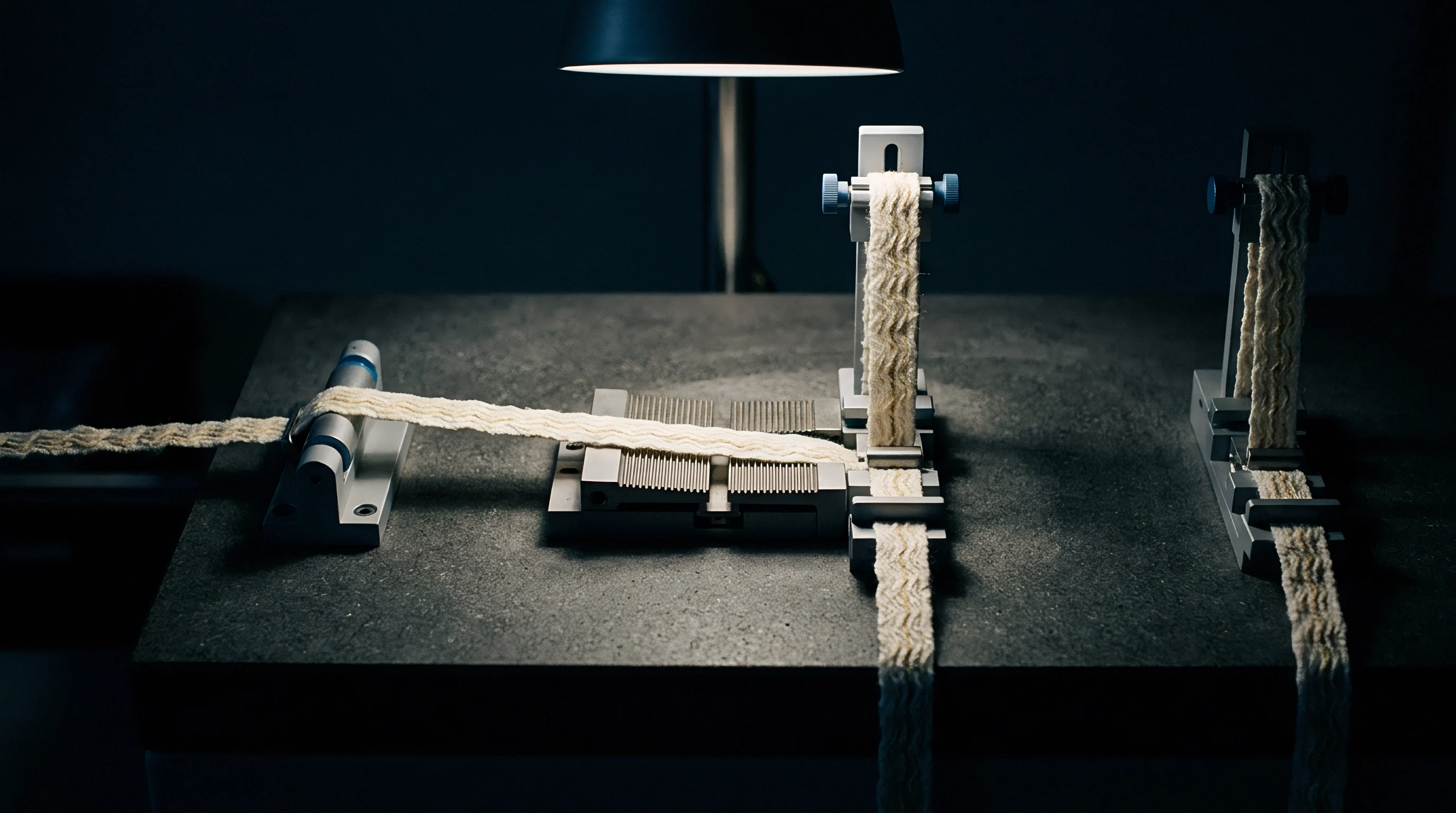
Predictive friction modeling determines actionable machine settings on commercial finishing lines. Continuous steam relaxation ranges operate at speeds between 25 and 90 meters per minute. Line speed governs total steam dwell time, fixing the position where fabrics reach terminal friction decay.
Machine overfeed rates must match the calculated contraction potential to avoid excessive longitudinal draw or fabric jamming.
Tension control zones within continuous stenter and compacting lines establish finished fabric yield. When overfeed exceeds structural crimp capacity, fabric buckles, causing horizontal crease marks and uneven selvedge tension. Insufficient overfeed maintains warp tension throughout the low-friction window, preventing natural crimp balance and causing downstream residual shrinkage during apparel fabrication.
Process control systems integrate predictive models directly into programmable logic controllers. Real-time infrared pyrometers measure fabric surface temperature at the steamer entrance while load cells track warp web tension before and after the steam box. The model calculates required chamber overfeed percentages and delivery roll speeds dynamically to match incoming lot properties.
A lot running through finishing without dynamic friction compensation sacrifices up to three percent of finished linear yield.
Lot-to-lot variations in sizing content, wax application, and spinning finishes shift the friction decay curve along the time axis. A shift of two seconds in relaxation timing alters the spatial location where yarn locking occurs on the pin chain. Systematic qualification protocols require testing incoming greige lots for extractable oil content and static friction coefficients before setting production line speeds.
How do subtle differences in chemical sizing formulations alter the steady-state residual friction coefficient when wet steaming transitions into dry heat-setting zones?